Ninja Gaiden Black Analysis
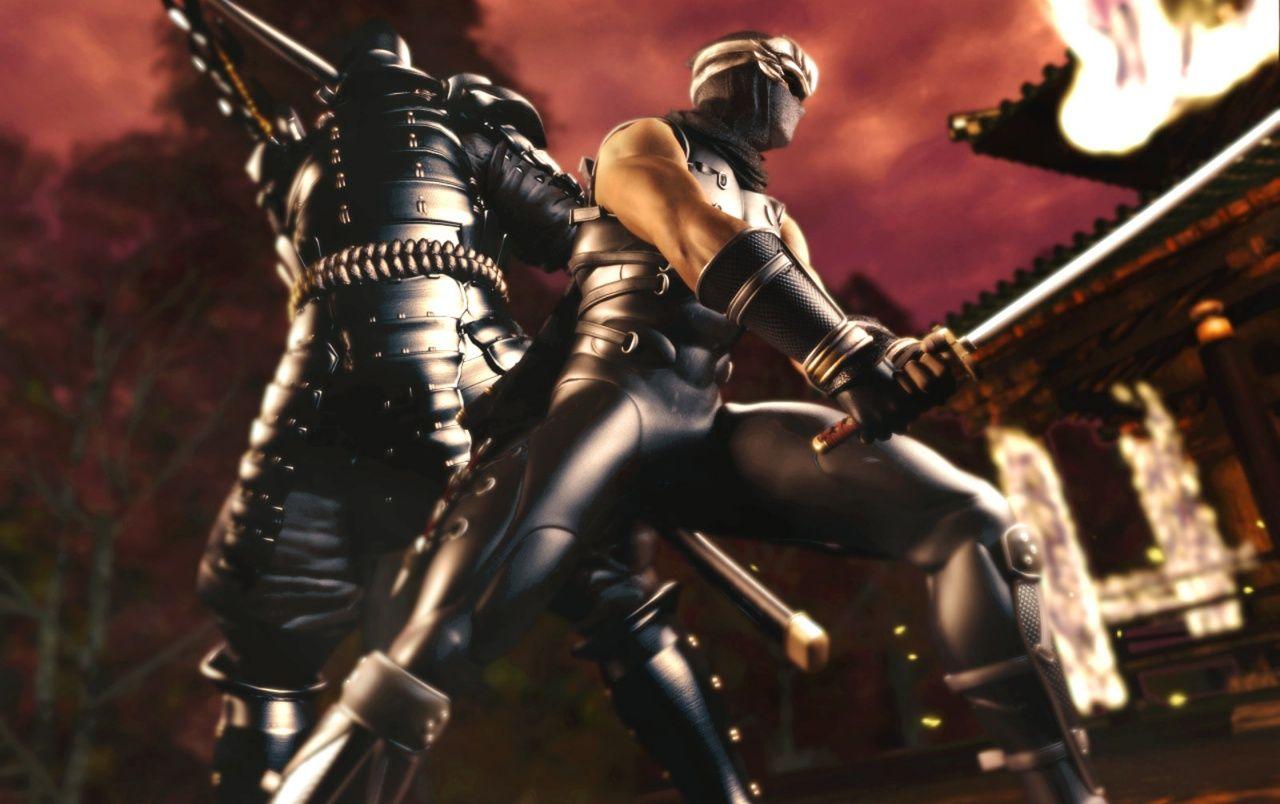 Over 20 years removed from its original release, it’s hard not to see Ninja Gaiden 2004 as anything but a revelation for the industry. Blending elements of 3D adventure games in the wake of Ocarina of Time and Resident Evil with an emphasis on punishing combat ala Devil May Cry, NG04 landed on a particularly interesting skew of action game design that still isn’t quite like anything that’s released since. Crucially, NG04 also came at the perfect time to take its own distinct shape among its peers - not too early that it ended up as an amorphous blob of scrappy ideas, but not so late as to come during the shift toward chasing cinematic trends. After two DLC expansions and one final revision in the form of Ninja Gaiden Black, this new direction for the series claimed a spot among the gaming pantheon as one of the most electrifying and impactful action games of all time.
… If that’s all I had to say, I don’t think I’d be sitting here writing this.
To speak candidly for a moment, I’ve had more difficulty gathering my thoughts on this particular title than almost any other I’ve played. After my first playthrough of the game back in 2022, I felt dejected. The core combat felt extremely satisfying, but roadblocks every 15 minutes made it so difficult to consistently have fun with the game. Who designed these bosses? Why are levels so confusing and annoying? Why did it feel like UT and Izuna Drop spam alone can carry you through much of the game? I was so mentally fried after my initial run that it even had me reconsidering my thoughts on other action games I didn’t particularly like. It felt like something at the core of the experience was the wrong side of a magnet actively repelling me from fully connecting to it, ultimately leaving me confused, frustrated and sad.
However, I couldn’t deny that something about the experience called to me, at least in its more flattering moments. Despite any frustration I felt, there was something about it that kept pulling me in, and just like a magnet, the repelling side quickly flipped and locked me in. After moving out of my parent’s place for the first time and immediately losing my job I was suddenly met with a lot of free time, and with this one particular game calling to me from beyond the clanking machinery and warm plastic of my Xbox, I was in.
With this newfound drive I was able to quickly get through the game’s Hard and Very Hard difficulties, but Master Ninja would be a much more gradual process. Through falling into a job I hated and a relationship I loved, my free time became much harder to allocate and NGB once again became much more exhausting. This is a dense game even by action game standards, with multiple heavily remixed campaigns and a skill floor that demands your full attention to avoid heavy setbacks, so much of my progress was extremely stagnated. As time went on I’d make progress little by little, continually flip flopping my thoughts on the game with time, and after finally nearing the end of Master Ninja 4 years after my initial playthrough, I still have a hard time putting things to words. NGB is a huge, ambitious, oftentimes frustrating experience, and I have such a hard time fully walking away from it.
There’s so much to talk about and discuss here, but the start of the game is probably the best place to, well, start. With 4 years to reflect, I think I can say with confidence that this might be the greatest first level in any 3D action game. Just about every element at play here is firing on all fronts: gorgeous set-dressing, varied combat arenas, cute quirks to progression and platforming, and enemies that never lose their bite on subsequent playthroughs (especially once you begin to climb the difficulty ladder). As far as vertical slices go, you can’t get much better than this.
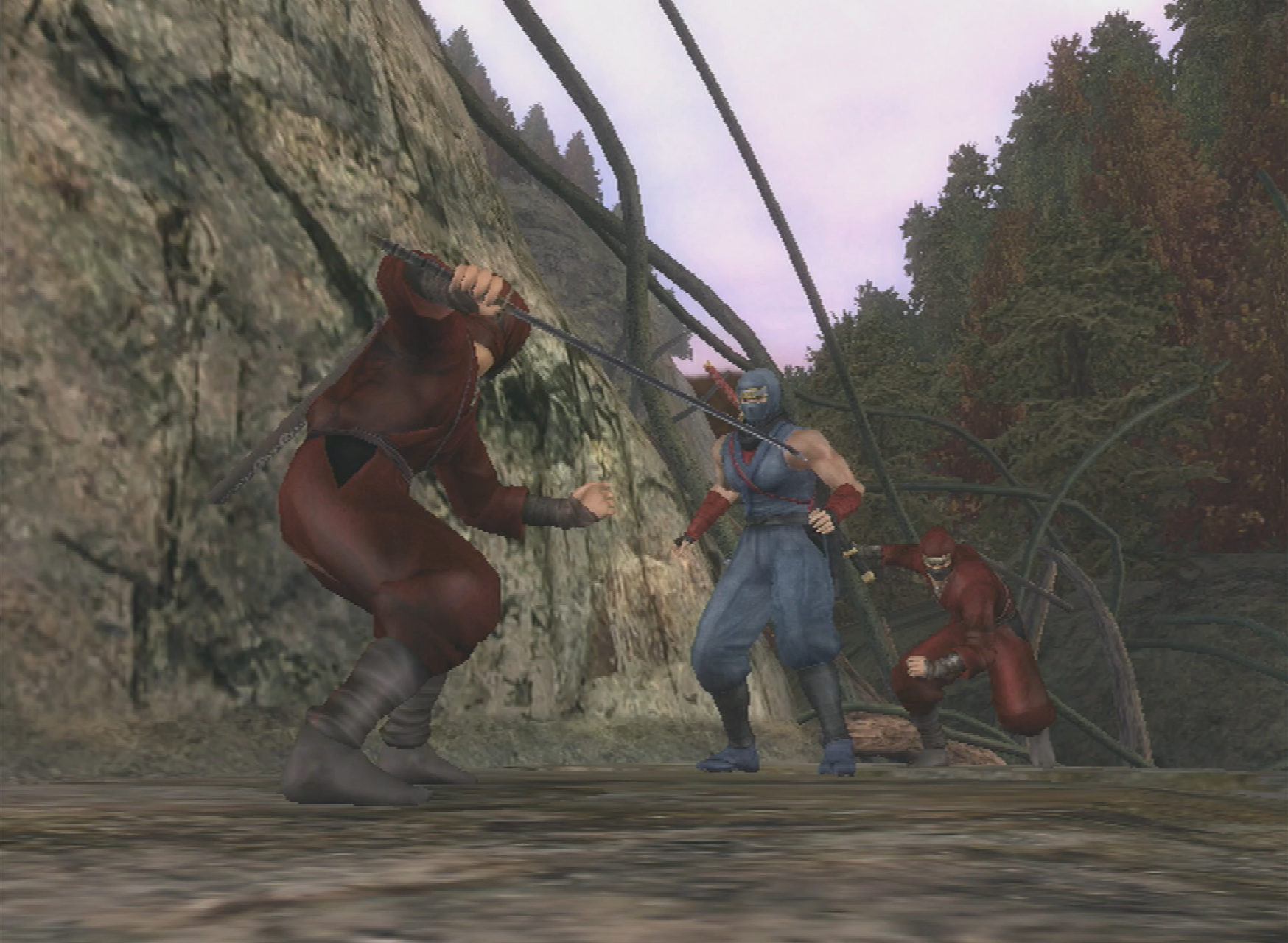 The opening stage does not waste more than a minute of the player’s time before throwing them into the action.
Something immediately apparent when you begin your ascent up the mountain and through the fortress, more than the number of traversal options at your disposal, is just how committal each of those options are. While the game allows for some amount of freedom in how you chain your kit together, most of your tools follow fixed, occasionally awkward arcs with limited room for adjustment. Some well considered level geometry does a good job at hiding this in service of selling the illusion of controlling an agile ninja, but you’ll be thrown right to the wolves as soon as you enter a combat encounter. Tools that felt light and effortless before can quickly begin to feel cumbersome and obnoxious, and I’m sure this is where the game can lose some players. I don’t say this to sleight the controls though, I actually believe it to be one of the game’s crowning achievements.
The brilliant thing about how this game controls, and I think the thing that keeps bringing me back, is its seamless blend of general character control and combat control. While a lesser game may segment its platforming and combat more overtly, leaving nothing but awkward movement challenges with no stakes and boring symmetrical arenas for combat, Ninja Gaiden blends these two into the very fabric of its DNA. What reads at first like ill-fitting movement tools in battles that take place in rooms clearly not designed for combat quickly blends together into combat that flows like nothing else, linking tools to control crowds with deliberate grace, finding hairpin space to make tricky jumps to evade and get to specific coordinates of the room, abusing invincible offensive and defensive maneuvers to bend enemies to your will, there’s so much to chew on from moment to moment.
Aiding in this frenzy is the game’s most iconic mechanic, Essence Charging. Upon death enemies will drop a colored orb of varying purpose, allowing you to stock up on money, heal, or fill your magic during a battle. However, by holding your heavy attack button, Ryu will suck in surrounding Essence to instantly charge his strongest attack to ascending levels of power (within the community, the first level of charge has been named the Essence Technique (ET), while the second level has been named the Ultimate Technique (UT)). ETs and UTs are absolutely devastating attacks that can completely swing a fight in your favor if things are going sour, but Essence Charging will all but entirely negate the usual effects of any essence you absorb. To make matters even more complicated, enemies killed by Essence Charged ETs and UTs will drop greater value orbs than they normally would. And so, a dilemma emerges: do you attempt to play without relying on ETs and UTs to safely reap the benefits of essence, or do you take the risk for a more immediate return on investment.
This would be an engaging enough question on its own, but in another effort to squeeze every bit of juice out of your toolkit, playing around essence is another layer of play that gets bolstered by this fusion of offense and defense. Holding the block button in any state prevents Ryu from absorbing essence, and this small mechanic is the lynchpin that holds every encounter together. While juggling active threats on screen, board control itself becomes even more important, with the ability to manipulate where Essence rests in an arena to pick up what you want exactly when you need to. On my first pass it felt way too easy to rely on UTs to nuke screens and completely miss out on the evasive part of play, but in retrospect I think I was missing the forest for the trees. Playing for ETs and UTs is the game, and that might not be to your taste, but considering everything these mechanics orbit around I don’t find them to be deterrents on the experience. Mad scrambles for open space to pop a charge or catch your breath for a moment never lose their luster, and there’s always that fear that an overlooked Ninja could grab through your block or smother you at any moment.
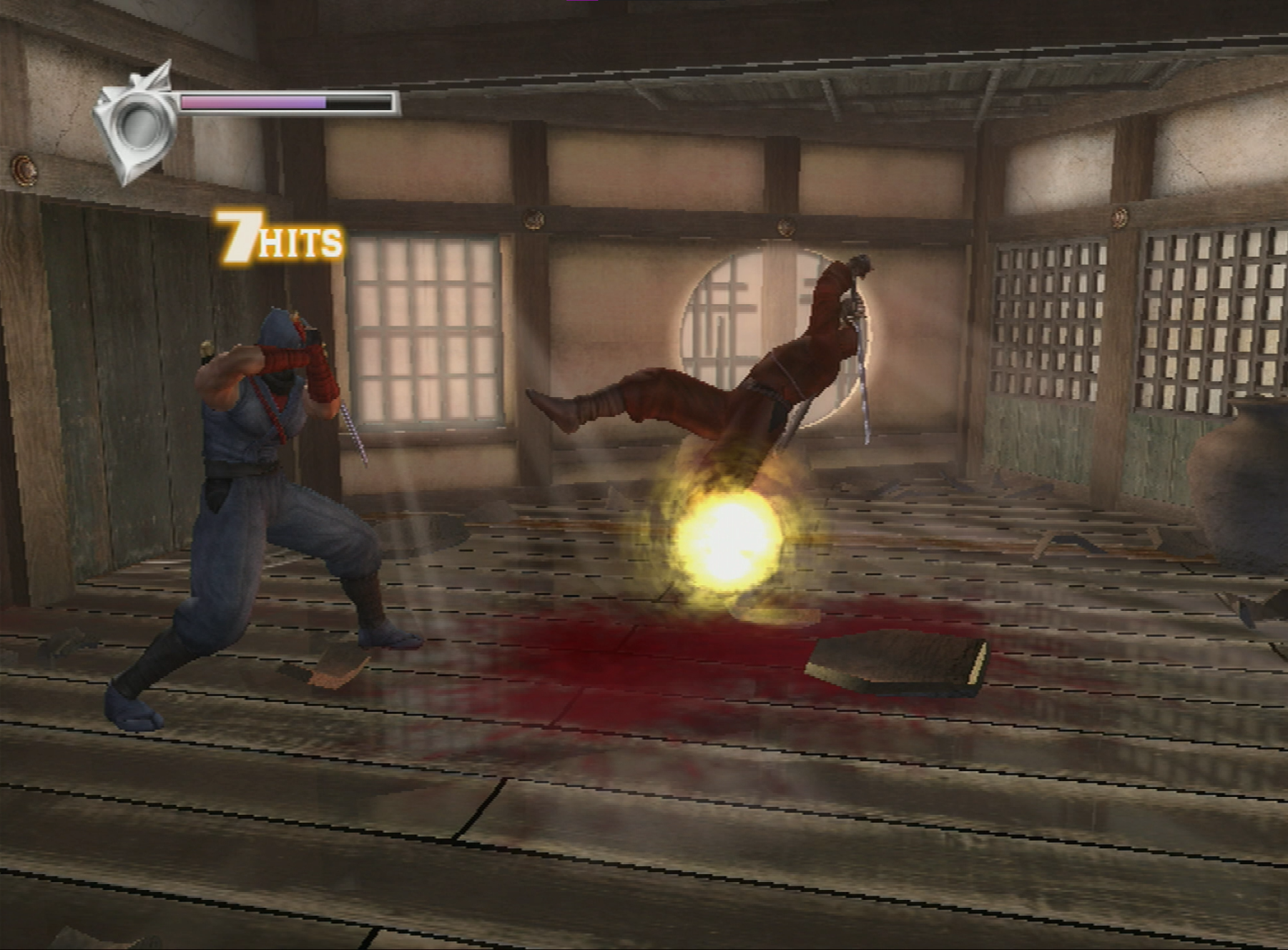 Being able to manipulate the position and timing of Essence Charges can make even single enemy scraps far more engaging.
Tying everything together is the game’s bestiary which is nothing short of brilliant. While some enemies may not be as complex as others, each serve a specialized function in combat and remains lodged in my brain even after months or years spent away from the game. Most impressively, even in cases where you aren’t fighting an especially diverse wave of enemies, NGB still manages to make these encounters feel dynamic through expansive movesets and unique combat arenas. The best example of this is easily the Ninja, an enemy who morphs and evolves frequently across difficulties but always follows the same ideals.
For example, let’s look at Red Ninjas: these guys have multi-hit strings, standard Shurikens and Incendiary Shurikens introduced by Black Spider Ninjas, a devastating command grab with no startup or end lag, and a ridiculous boost in attack power compared to older Ninja variants. These enemies are absolutely ruthless, constantly filling the screen with threats and limiting the number of “safe” spaces on the board. Paired with their frantic jumps and quick unblockable ground options, Red Ninjas force the player to constantly maintain space, be on the move, or throw themselves in the face of danger with a well timed invincible attack of your own if you can identify their chosen string.
Just about everything about the core of the combat design is nothing short of breathtaking. From movement’s interplay between offense and defense, to the suffocating combat encounters of various shapes and sizes, to the thrill of playing at low health and barely scraping by with a well placed UT, the list goes on. Beyond sporting a pretty annoying boss, the first stage of NGB pretty perfectly paints a picture of the ideal action game to me and encompasses everything I adore about the combat. However, for as much as I’ve gushed so far, this isn’t telling the full story - this razor sharp facade fades just as fast as the quiet Japanese village aesthetic that frames the opening of the game.
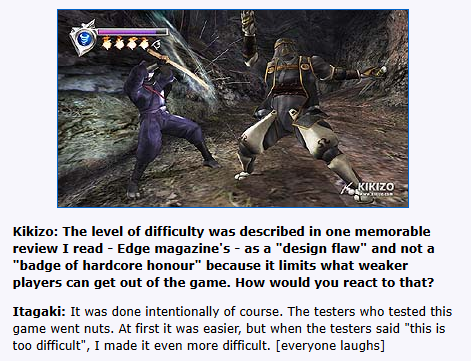
Whenever you’re really behind the wheel, never for a second does NGB let off the brakes. This is a game that follows the law of “sink or swim” more than most, a game that refuses to tutorialize or hold your hand for a single solitary second if it means a player could fart their way past a challenge, and on the whole this is a philosophy I must respect. While surface level frictional elements to the game may sprinkle its legacy with frustration and infamy, I believe this pillar of Ninja Gaiden’s design is what’s fueled its longstanding appeal. But perhaps the only thing more infamous to Ninja Gaiden than its difficulty is its creator, a man who fought for decades on the frontlines of challenging games, uncompromising visions, and tacky sunglasses, Tomonobu Itagaki.
Itagaki’s rockstar attitude was deeply ingrained within a lifestyle he committed to until the day of his untimely passing, and it allegedly got him into some trouble with his peers. I don’t want to sour the mood with the past sins of a man who may not have been the best guy in the world on a detached blog months after his death, but I’d feel silly to not at least mention it. Ultimately, his past behaviors (both for good and for ill) have now been carried along with him beyond the grave, so academically I don’t feel too much hesitation in acknowledging his work and simply appreciating it as an expression of his more admirable artistic sensibilities.
Anyway, while Ninja Gaiden Black stands as a remarkable achievement for its combat design, this doesn’t come without a cost. NGB is a game that exists with minimal compromise, and this is undoubtedly reflective of the experience that surrounds the core gameplay. Rather than having stages take place in wholly isolated areas, many of NGB’s 16 Chapters take place in shared locations that cross between each other, with a greater percentage of those finding the player exploring the city of Tairon. On a first playthrough this place can feel daunting, with multiple routes leading to dead-ends or scattered collectables while the main path is blocked off or hidden. Even with a map of the city, it can be rather disorienting at first to catch your bearings and make meaningful progress.
This, I feel, is the real glue that defines this experience. From mutual discussions I’ve had as well as threads I’ve observed from afar, this can be the make or break of NGB for people, and unfortunately I think I lean more towards the latter. Beyond spacing out the good stuff more than I’d like, these large stretches of dead air rarely manage to justify themselves with anything that elevates the core design of the game. More often than not, level traversal is filled with backtracking with keys for progression, or getting bogged down with puzzle and movement challenges. Neither is able to take advantage of the good that the game offers, and neither really stand as remarkable qualities on their own.
Anything that necessitates movement within these spaces can be especially frustrating as the layout of these trials can be very finicky in what they expect from Ryu, leading to the player smashing their head against the wall until they can perform something approximating the correct sequence of inputs to proceed. I know at the start I praised the movement for the ways in which it sold the illusion of being a Ninja, but roundly speaking, this is just not a game built for precise platforming. Executing a tight movement challenge can be a really rewarding thing to have in a game, but with the handling model here, it never feels like I’m the one imposing my own solution on a problem like I am in combat, it feels like I’m just being tested on an isolated skew of the game that won’t be applicable anywhere else.
Graciously, the punishment of failure for these sections usually isn’t anything more than a small bit of time loss (though the game isn’t afraid to put platforms over bottomless pits from time to time), but perhaps as a result of these low stakes environments, movement isn’t able to feel as electric as it can in moments where you’re successfully able to implement it into the combat. Admittedly, there is some level of satisfaction to be gained in being able to get through these sections efficiently and quickly - few things feel more ninja-like than placing as few steps as you can within a space before exiting without a trace, and that does come through here, but never does the game make me feel quite as connected to the city or catacombs as I did with the ninja village at the start of the game.
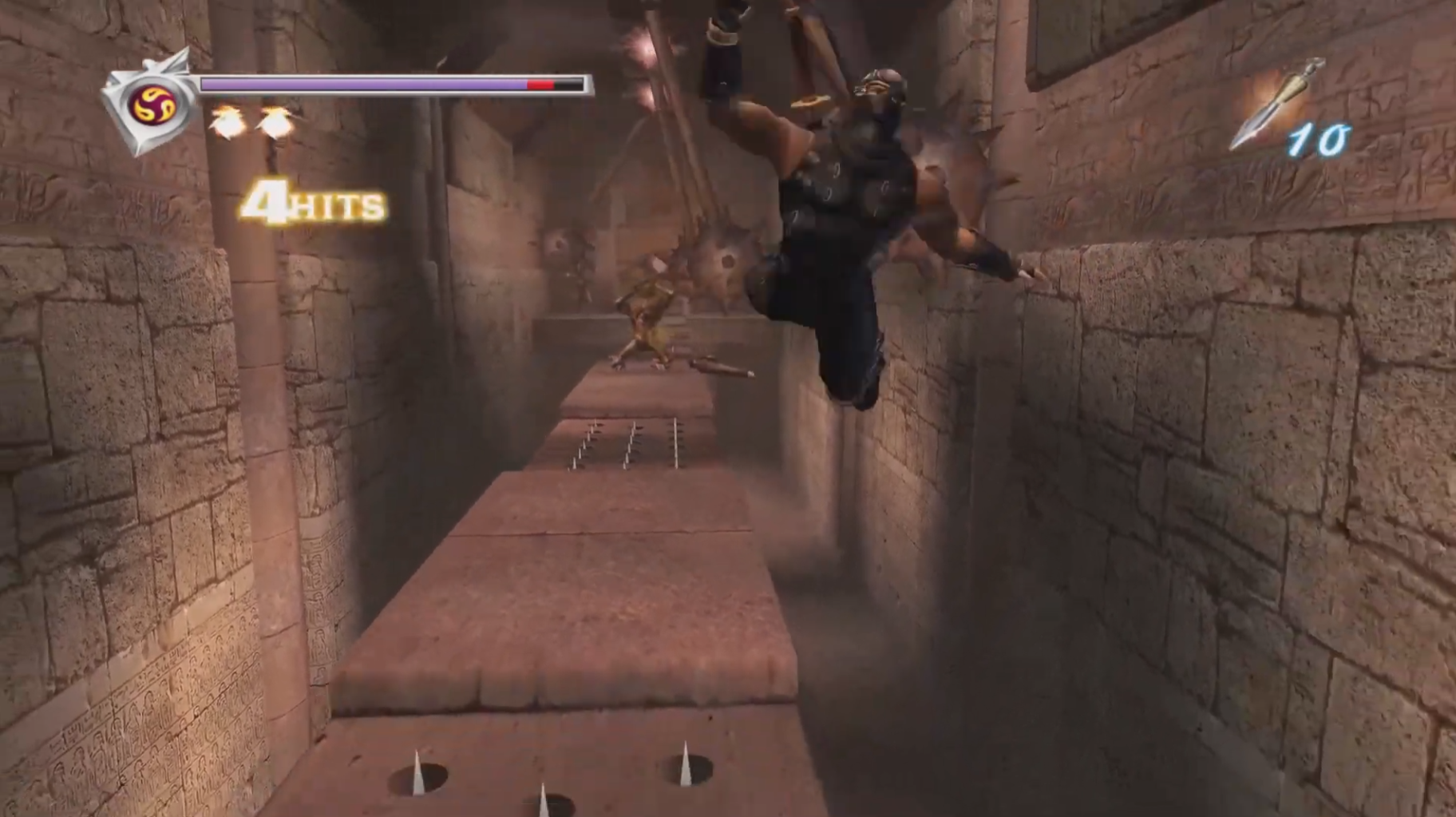 Once you reach the catacombs, most of the game’s best moments are already behind you.
Thankfully, the levels aren’t all bad. My description here suggests they serve as nothing more than breaks from the action, but that would be a little disingenuous. Rather than divvying out combat between a handful of required encounters and nothing more, NGB goes for a less regimented approach, filling particular corners of the map with a consistent handful of enemies to fill the space. These “ambush” style encounters can feel really threatening on your first playthrough when you don’t know when or where they’ll appear, and on the whole, they largely hold their weight even after your 5th playthrough. This is the shit the game does best after all, and every moment in the game spent not landing Izuna Drops has me wondering when I’ll be blessed with the opportunity to land more.
Having said that, I do think this divided approach to combat unfortunately fuels another area of the game that remains frustrating even up to the journey through Master Ninja difficulty. While I cherish the game’s challenge in how ruthless enemies are and for how little it cares about the player at points, it can undoubtedly make the game feel exhausting to play. While enemies are around every corner, huge moments of progress are often spaced far apart, and it can occasionally be extremely difficult to get back to these gates in progress in one piece to take another stab at whatever wall the player is at. I fundamentally refuse the modern notion that games shouldn’t have the player redo challenges they already accomplished, as this “marathon” approach to difficulty targets a different skillset that isn’t just repeating one challenge until the pieces fall into place (arcade games are almost entirely built on this style of design), but with how brittle Ryu is, the foundation of this philosophy can occasionally feel compromised.
I have no beef with enemies with having unreactable grabs that force the player to navigate the play field with intent, but when a stray grab erases half my health bar and I lose 10 minutes of progress in these levels, that’s when I start to deflate. Nothing feels worse here than executing a slow, chunky platforming challenge with archers in the catacombs for progression items or a swimming section followed by a difficult Red Ninja encounter, only to finally reach the boss room and get killed by an enemy attack you couldn’t see or get counter-hit by a boss that randomly defended your Flying Swallow and grabbed you as you landed. After getting through many of the game’s toughest moments, rather than feeling rewarded in the fact that I was able to take down something I struggled with for an extended period of time, I just feel relieved that I don’t have to do it again.
“Ninja Gaiden Black has shitty bosses” feels about as valuable of a critical statement as “The Izuna Drop is the greatest move in all of video games”, but I think it still needs to be said, Ninja Gaiden Black has some pretty shitty bosses. It would be one thing for the game to drop a difficult encounter at the end of a particularly brutal stretch of the game without checkpoints or saves, but the design of the fights themselves range from mildly questionable to actively making me put the game down. In action games, bosses tend to swing between two different extremes of design: passive/unreactive to the point where they’re just punching bags, or actively avoidant and obnoxious to engage with on a basic level. The older I get the more I recognize that bosses are almost never the best parts of these games and I shouldn’t let that define my experiences with them, but it doesn’t have to be this way.
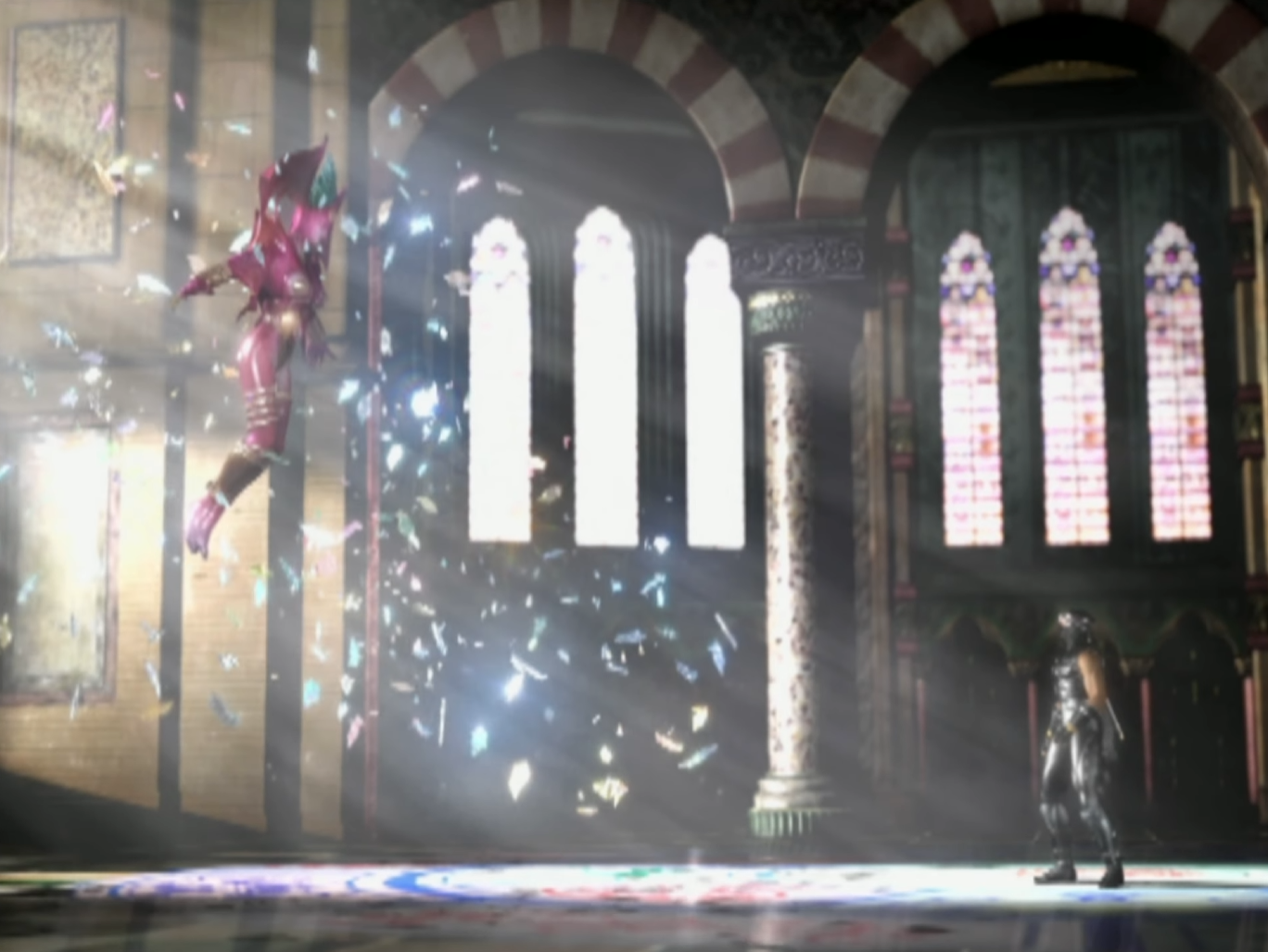 Not a single frame of NGB has done as much psychological damage to me as this one.
Few standouts of the genre prove that it is entirely possible to design one-on-one encounters with enough flexibility and grace to be just as engaging as group fights focussing on juggling threats - Griffon in Devil May Cry successfully tests endurance while forcing the player to navigate dynamic environmental threats in the arena, Jeanne in Bayonetta dances between offense and defense so quickly it can be hard to tell where one ends and the other begins, and while not particularly deep games, the Yakuza series has historically done a great job at selling the sensation of just beating the brakes off someone, elevating its encounters through its storytelling and great gamefeel on a surface level. Different games have different priorities so its not fair of me to say one approach is strictly better than all others, but developers could be doing a far better job at designing their fights to avoid having them boil down to “call and response” affairs where the player takes turns getting free hits while waiting for a telegraphed counter-attack to start the cycle over again.
While NGB makes a clear effort to make its bosses feel impenetrable and threatening, it comes at the cost of engaging design. Bosses are often lightning quick, their states can be extremely difficult to decipher, and many are among the most punishing threats in the game. While every encounter has moments where the player is intended to engage, they can often be either completely out of reach from your attacks, or if they are in range, completely avoid your attacks at random. While bosses aren’t going to break out of your combos early and punish the player during structured offense, getting anything started to begin with can feel like pulling teeth, and this can put the player at unnecessary risk of borderline instant death (side note since I don’t know where else to put this: I don’t want to be too critical about the lack of QoL in a 20 year old game held back by hardware restrictions, but the the amount of time it takes to reload a game on death paired with the lack of checkpoints on bosses makes every single encounter a thousand times more frustrating than they really need to be).
Alma is perhaps the most notorious Fiend in the entire roster. This is the big one I’ve alluded to before this point, and both encounters with her are some of the lowest points in the game. If it’s not the camera getting snagged on the arena making it difficult to properly avoid her unblockable attacks, it’s getting grabbed out of the recovery frames on an attack or struggling to hit her at all for extended periods of time. Awakened Alma does fix some problems here by placing the fight in an open field to let the camera behave consistently on top of the player having stronger UT options at this point to cover her grounded approach, but the same principles remain. The risk/reward of every button you place is horribly skewed, and success never feels properly rewarding.
At their worst the bosses are almost enough to make me never want to play the game again, but even at their best they rarely reach their full potential. Most bosses in the game aren’t quite as defensively stubborn as Alma, but other problems feel all too familiar: punishment feels sharp and random, everything just feels like a punching bag, and nothing consistently plays to the game’s strengths. Admittedly, higher difficulties are able to elevate what’s here, at least somewhat. Everything above normal adds different types of standard enemies to most boss encounters, giving the player way more to juggle in the moment and going some way towards making the fights feel more interesting. While some fights don’t gain much from the addition (with how passive Murai is in Chapter 1, the added enemies just feel like distractions), some can actually completely transform.
The boss of Chapter 2 on higher difficulties might just be my favorite fight in the game - the added mages are able to take advantage of the long sightlines provided by the bridge, and the simple movement pattern of the horseback-riding Samurai allows the player to place some insanely satisfying UTs with the right timing and positioning. Either one of these elements wouldn’t be enough to carry the fights on their own, but layered together, they create an obstacle unlike anything else present in the game (addendum: while researching for this analysis I discovered you can actually utilize Ninpo to knock the Samurai off the horse as soon as the fight begins, eliminating a large element to the fight. This doesn’t ruin it for me as the arena and audio tells on the Mages still allow for an interesting dynamic regardless of what you’re prioritizing, but it’s a bummer the most defining threat of the encounter can be neutralized so effortlessly).
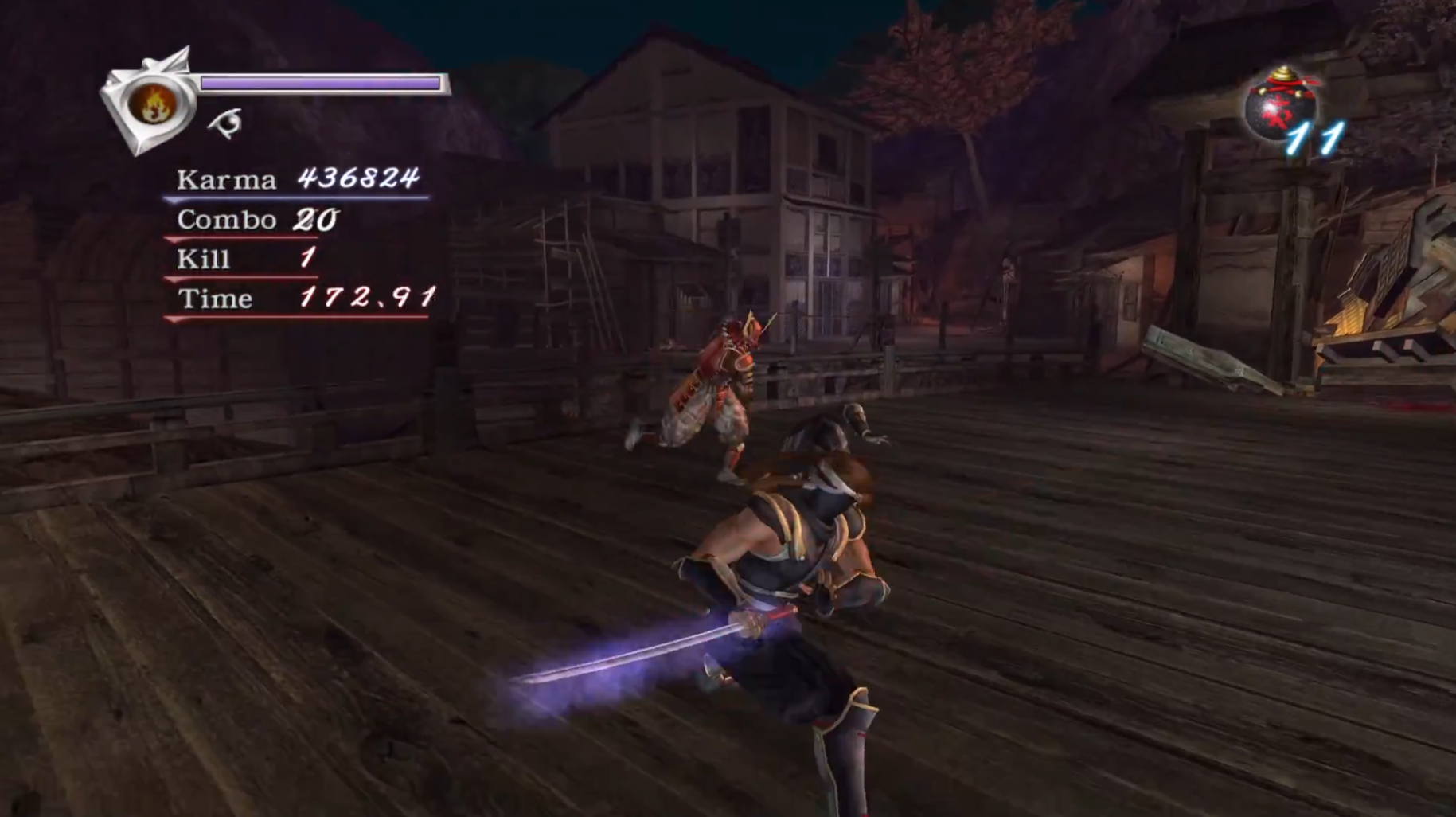
In some cases this can naturally feel like more of a detriment (the addition of Ghost Fish in a particular late-game encounter feels completely misguided) but on the whole this doesn’t make the higher difficulties considerably less enjoyable, nor does it add as much as I’d like. To cover my ass here, my beef has little to do with the difficulty. I’ve played (subjectively) harder things, slammed my head against more brazen obstacles, this is the type of shit I generally live for. The big reason why these encounters are so frustrating is because the combat design is so exemplary for the genre, and yet the bosses feel more detached from that core than almost any other action game I’ve played. I can get down with being testing on something that might not be what the title does best (The Wonderful 101 is my literal favorite game ever if you needed any convincing of that), but what’s here is just not it. When assessing a game like this I try to consider the experience as a whole, and sometimes that does have me reframing my perspective on some thornier parts of the journey. Occasionally this approach can let me gloss over the shitty parts to a game I otherwise love, but even in a vacuum, the rough patches here really do hold the experience back for me.
Despite that, I can’t stop thinking about this game. I can’t stop talking about it, playing it, getting elevated about it, and 4 years after my initial playthrough, I somehow can’t stop writing about it. Something about this game just poisons my brain and keeps me coming back - the high of landing a UT that steers the momentum of a fight always gives me a rush like no other, getting through an encounter by the skin of my teeth makes me ascend to another plane of reality, and just hitting buttons feels really fucking good in a way other action games wish they could replicate. Despite my strong feelings towards some elements of the game, I even find myself at the tail end of the adventure shifting my perspective on some sour spots I maybe felt a bit more stubborn on a few years ago. One mechanic I neglected to mention before was the ability to chain Essence between encounters, allowing the player to gain an incredible advantage at the start of your next encounter with an ET or UT if you can get there before Essence despawns. While the spacious maps can be a nightmare to traverse without direction, Essence exists “on the board” for about 10 seconds before despawning, allowing for chaining you could never have imagined was possible when you were first fumbling through the streets of the city. It’s an incredible motivator to learn the lay of the land, and turns what initially feels like rigid platforming into a cool execution test.
Reflecting on the journey as a whole, it’s not hard to see why NGB has had such a grip on me for so long. As a kid it served as a monolith of the horrifying unknown, and in a funny way, it still feels like the disc contains incalculable evils despite doing just about everything I can in the game (Mission Mode notwithstanding). To borrow a phrase from my good friend Heather, “reaching a point of basic consistency feels like an impossible dream”, and this might be the secret ingredient that forces this game to stick in my mind for months after playing. While I can’t deny that so much of the game holds me back from really committing myself to it like I have for its contemporaries, it really does feel singular in a way that not many games do.
In many ways, Ninja Gaiden Black is a total mess. It constantly pulls itself in too many directions, undermines itself with sections that don’t play to the strengths of the game, and while I respect the uncompromised vision from Itagaki and the leads on the team, I can’t help but wonder what a Ninja Gaiden game would look like with more focussed goals, one where the insanely stupid ideas elevated the combat rather than distracted from it (maybe one day I’ll get to write about a game like that…). Over 20 years removed from its original release, NGB has, in many ways, been somewhat outclassed in the greater pantheon of 3D beat ‘em ups. Some have been able to condense their ideas into a more digestible package, some found solutions to many of the problems NGB presents, and some are just a little more consistently fun to play through from beginning to end, but in totality, Ninja Gaiden Black still holds a distinct position in the constellation of gaming. It may not be the greatest action game ever made, but not every action game has to be. Future games in the genre would be silly to not learn lessons from some of the ideas found here, and I can’t imagine an industry where its moments of unparalleled brilliance are fully lost to time.
Comments
You can use your Bluesky account to reply to this post.